Understanding De-escalation & its Limits
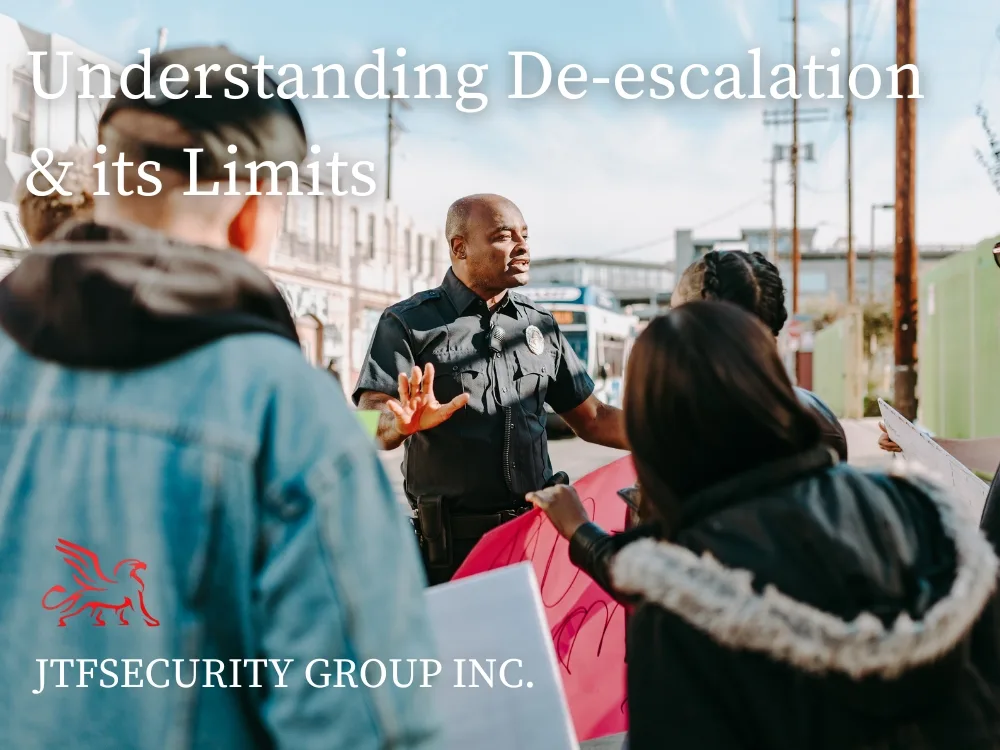
De-escalation is often presented as a silver bullet — a universal solution for calming tense situations. In training rooms and policy documents, it’s framed as a method that, if applied correctly, can reliably bring down the temperature of any encounter. But anyone with real-world experience knows that’s not always the case.
De-escalation works best when time and safety are on your side.
- At its core, de-escalation is a process—a series of intentional communication processes designed to reduce tension and reintroduce control into a dynamic situation.
- The process takes time; given enough time, every situation involving subjects that can be engaged is, theoretically, de-escalatable.
- De-escalation also requires space and demands a level of personal and environmental safety that, frankly, isn’t always present.
In an ideal world, every responder would have the luxury of time to implement all the various and necessary steps to de-escalate any given situation, along with all the resources to offer meaningful support, and the backup to stand down when needed. Under those conditions, many people can be influenced, persuaded, even redirected from high-risk behaviours. When a person in crisis feels heard, seen, and safe, they are far more likely to cooperate. This is where de-escalation thrives: in the window where a scene is deemed safe and communication can begin, but also a scene where time is afforded.
But the real world often moves faster than that.
Much of human behaviour is patterned and predictable. Systems are built around this predictability — expectation models, response checklists, communication scripts. And when a situation veers off-script, support systems kick in. Agencies are activated. Resources are notified. Contingency plans unfold.
The challenge arises when time runs out and risk increases before resolution is reached. This is the inflection point — the moment when the communication-based de-escalation model begins to strain under the weight of urgency and danger.
When safety is compromised — whether due to weapons, volatility, or unpredictable behaviours — responders may have to pivot. The focus shifts from calming and connecting to containment and control. In those moments, the principles of de-escalation don’t disappear, but they take a different form. A calm tone may still be used, even during rapid commands. An empathetic stance might be maintained even while enforcing boundaries. But make no mistake: the space for full dialogue is gone.
De-escalation is not a guarantee. It’s a tool.
The more we understand its limitations, the better we can use it. It is most effective when it’s supported — by a team, by training, and by a structure that allows for flexibility when things don’t go to plan. “De-escalation” is one of a dozen communication tools and models, and it has a rather broad range of use. It is not a replacement for tactical readiness, nor is it a failsafe. But when time and safety are present, it remains one of the most powerful tools in a responder’s toolkit.